
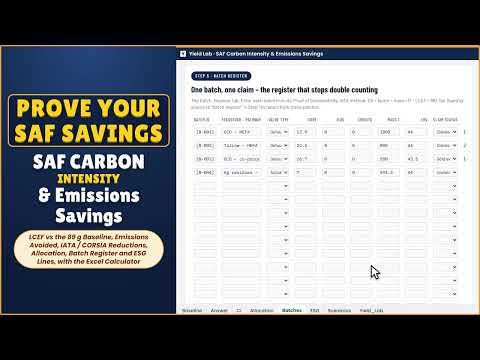
What Is a Carbon Intensity Score?
A carbon intensity score measures lifecycle greenhouse gas emissions per unit of energy, usually in grams of CO2 equivalent per megajoule (gCO2e/MJ). SAF's savings are measured against a fossil jet baseline (89 gCO2e/MJ under CORSIA). Lower carbon intensity earns more under schemes such as LCFS credits and 45Z.
How SAF Reduces Emissions
SAF cuts lifecycle emissions mainly because its carbon comes from waste, biomass or captured CO2 rather than fossil crude. The calculator applies default or actual values for your feedstock and pathway, shows the saving per batch and per year, and keeps the reporting basis consistent so the same fuel is not counted two ways.
Who It Is For
SAF producers, airlines, corporate buyers and sustainability teams who report or sell SAF emissions savings.
Save With a Bundle
SAF Expansion Pack
$4975 SAF tools: feedstock pathways, blend economics, ASTM D7566, certification and carbon intensity (value $745).
See what is included →Complete SAF Suite
$997All 12 SAF tools from pathway selection to compliance (value $1,888).
See what is included →Hyvnd All-Access
$1,997Every Hyvnd fuel and SAF tool, all 45 tools (value $5,956).
See what is included →Institutional Fuel Deal Execution – Private Mentorship
Move from scattered industry information to a disciplined institutional execution path, with better clarity, documentation flow and mandate positioning.
- Full institutional fuel deal curriculum: from mandate positioning to deal progression and closing structure
- ICPO, LOI, FCO and SPA templates and checklists for deal readiness
- Guided review of your live deal pipeline: what is credible, what is weak and what needs restructuring
- Mandate positioning, refinery and trader communication, plus deal triage to filter fake offers
- All 3 programs: Foundations Fuel Trade ($497), Global Fuel Trade Vault ($1,497) and the Private Mentorship ($7,500)
- Every Hyvnd tool (refinery, SAF and beginner) with step-by-step walkthrough videos
- 1 year of fuel deal execution support and private access to updates
SAF Carbon Intensity: Frequently Asked Questions
What is a carbon intensity score?
Lifecycle greenhouse gas emissions per unit of fuel energy, usually in gCO2e/MJ.
How does SAF reduce emissions?
Its carbon comes from waste, biomass or captured CO2, so lifecycle emissions are lower than fossil jet fuel.
What is an LCFS credit?
A credit under a low carbon fuel standard, such as California's, earned when a fuel's carbon intensity is below the standard.
What format is it?
An Excel workbook.
Report the savings once, and right
One method for carbon intensity and its value.
Not tax, legal or investment advice. Rules and prices change, so re-verify before use. Example data is fictitious.