
Hyvnd Academy of Excellence
Pronounced: “High Wind”Fuel Trading Training For Beginners & Professionals
Learn how real fuel deals work, step by step, from the first offer and the trade documents to payment and delivery. Our oil and gas trading courses cover EN590 diesel, Jet A1, CST180 fuel oil, SAF and one-to-one mentorship.
- Real Deal Training
- Global Market Access
- Private Mentorship
- Scam-Safe Process
Enrolled
Available
Reached
Experience
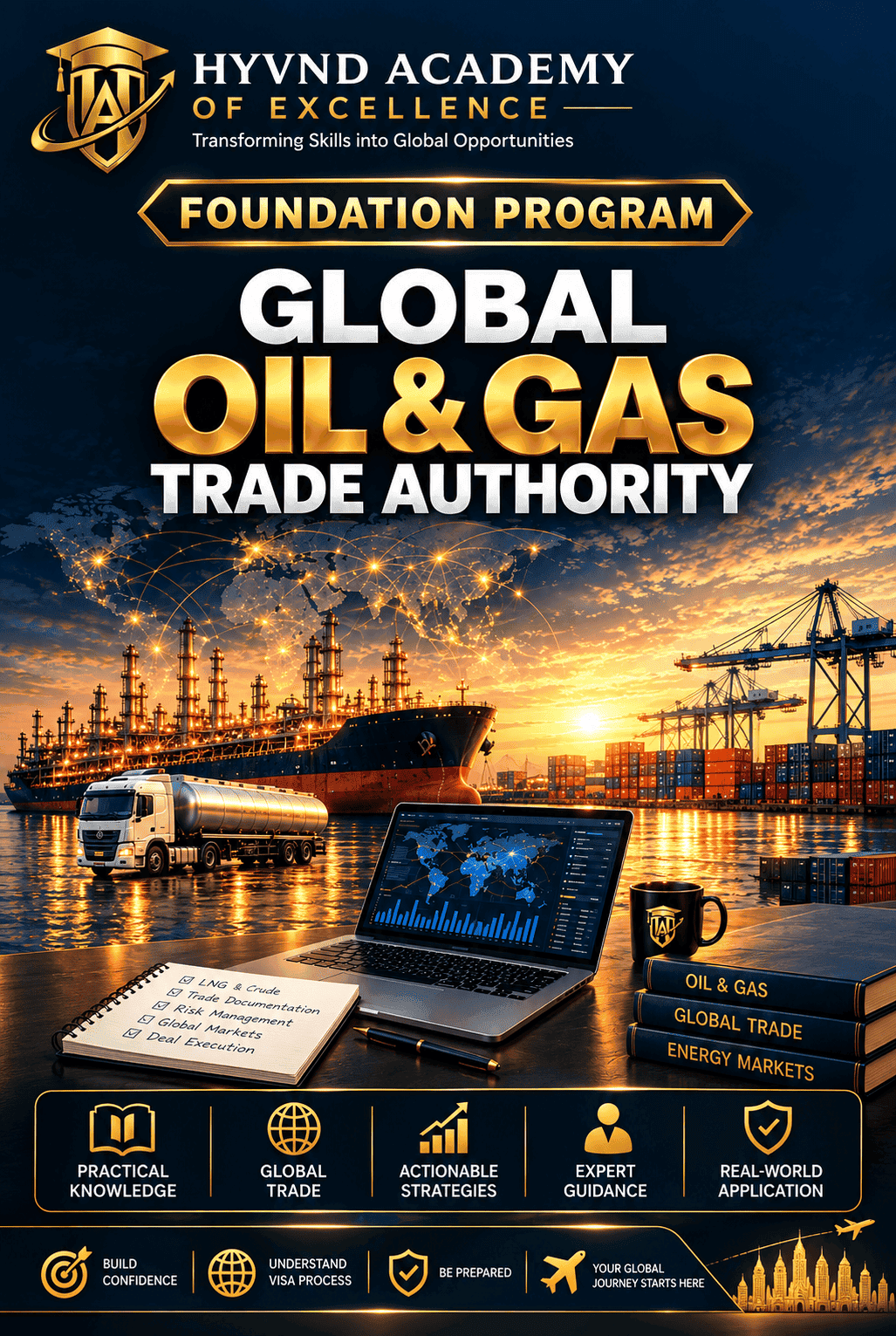
Start With the Oil and Gas Trading Course for Beginners
The Global Oil & Gas Trade Authority Foundation Program is the best place to begin. You will learn how fuel deals really move from first enquiry to delivery, who the buyers, sellers, brokers and refineries are, and the plain trade language you need before you speak to anyone in the market.
- See how the global oil and gas trade is built, including who the market players are and how a deal moves from offer to delivery.
- Learn where brokers, mandate holders, fleet operators, buyers and suppliers each fit in the chain.
- Get comfortable with trade documents and the way professionals write and speak to each other.
Start with the basics, see the market as it really is, and move on to bigger deals with more confidence and fewer costly mistakes.
Learn Fuel Trading From First Offer
to Final Delivery
Our three fuel and commodity trading courses cover the full path: the basics of oil and gas trade, hands-on deal work with a mentor, and the fast-growing market in sustainable aviation fuel (SAF).
Global Oil & Gas Trade Authority
Made for beginners starting out in fuel trading, and for brokers, mandate holders, fleet operators and business owners who want a clear base. You will learn how the market is organised, how deals are structured and how to speak the language of trade.
See the Foundation Course
Fuel Deal Execution Mentorship
A small, closed group for professionals who are ready to work on real fuel deals. You get one-to-one coaching, feedback on your own deals, help with mandates and letters of intent, document checks and direct access to the instructor.
Apply for the Mentorship
Sustainable Aviation Fuel (SAF) Trade
SAF is one of the fastest-growing fuel markets. Learn how airline supply chains work, which rules and incentives apply in different regions, and where a new trader can find a place in this market.
Explore the SAF CoursePrivate Fuel Deal Mentorship With the Instructor
Skip the classroom. Work through real fuel deals with hands-on guidance, live market insight and honest feedback, built for serious professionals.
Fuel Deal Execution
Private Mentorship Program
A closed group for professionals who are ready to work on real fuel deals. You get coaching at every step, from your first offer to the final document check.
Your instructor: Rizwan Quazi, Managing Director of HYVND Holdings Private Limited. With more than 20 years of experience in international business and the global fuel trade, he brings practical knowledge of trade and service documentation and commercial development, with professional skills for international business associated with the University of London. He is active in the fuels sector, supporting large-scale fuel transactions that move forward only with verified supply, qualified buyers, regulatory compliance, due diligence and signed contracts.
- 👉Private 1:1 coaching sessions
- 👉Feedback on your real deals
- 👉Refinery and supplier alignment support
- 👉Help with mandates and letters of intent (LOI)
- 👉Document review included
- 👉Direct access to the instructor
Fuel Trading Training Built
to Help You Close Deals
Every lesson is based on real fuel deals and the steps professionals actually follow to complete them, from the first conversation to payment and delivery.
Real-Deal Focus
Lessons come from live fuel deals, not textbook models. Each idea is tied to how a real EN590 diesel, Jet A1 or CST180 cargo is offered, checked and closed.
Professional-Standard Methods
Learn the checks and routines used by trading desks, refineries and brokers: mandate checks, bank instruments such as letters of credit, and bank-to-bank messages such as MT799.
A Clear Step-by-Step Path
See the whole deal from first contact to final delivery, so you always know where you stand and what comes next.
Trade Documents Made Simple
Understand the documents every deal depends on: the soft corporate offer (SCO), irrevocable corporate purchase order (ICPO), letter of intent (LOI), proof of funds (POF), letter of credit (LC) and MT799 bank message. You get real templates and guidance on when to use each one.
Scam Awareness Built In
Spot the red flags, fake documents and pressure tactics that cost newcomers money, and learn how to check a seller or buyer before you commit.
Up to Date With the Market
Stay current with changing trade practice, including sustainable aviation fuel, green fuel rules and the move to digital documents.
Built From Real Frustration.
Designed to Solve It.
Hyvnd Academy of Excellence (say it as “High Wind”) did not begin because someone wanted to teach. It began because too many capable people were losing years chasing fuel deals they had no clear way to close.
Our founder spent more than 20 years in the global fuel trade and watched the same story repeat: smart, ambitious people entering the market with no honest guidance, losing time to fake mandates and unreliable brokers, and chasing deals that went nowhere because nobody had shown them the real process.
Many courses in this space are taught by people who have never closed a deal. They share theory but no working method. Hyvnd Academy was built differently.
Every course, template and checklist here comes from deals that were actually carried out , not guessed at. The lessons are practical and in plain language, taking you from confusion to clear, confident action.
Today we train fuel traders, brokers, buyers and business owners in more than 20 countries, and they all learn the same lesson: success in fuel trade comes from structure, not luck.
If you have ever felt like an outsider in global fuel trade, this academy was built for you. We will not sell you dreams. We will show you the real process the industry should have taught you from day one.
From First Question to
Confident Fuel Deals
A six-step path that takes you from the basics of fuel trade to carrying out and growing real deals.
Learn the Basics
Understand the whole market: the people involved, how documents flow, and the trade language professionals use every day.
Understand How Deals Are Built
See how a deal is put together, from the seller’s offer (SCO) to the buyer’s purchase order (ICPO) and letter of intent (LOI), and who is responsible for what at each stage.
Use Practical Frameworks
Apply proven methods to real deal examples: shaping proposals, working with refineries and handling the paperwork and payments of a live trade.
Learn to recognise scam set-ups, weak paperwork and due-diligence gaps, then build your own risk checklist for every deal.
Identify scam structures, compliance traps, and due-diligence failures that derail traders — then build a personal risk-control framework for every deal.
Communicate Like a Professional
Write and speak with confidence, from clear LOIs and mandates to conversations with refineries, buyers and banks.
Keep Deals Coming
Go beyond a single transaction. Build a steady pipeline, keep good relationships and prepare for long-term growth in the fuel and energy markets.
Fuel Trading Training for People
Ready to Start Making Deals
Whether you are new to the fuel trade or already working in it as a broker, buyer or bunker trader, these programs are built for people who want practical results and clear, honest guidance.
Fuel Procurement Managers
Buyers who source fuel for their company and want clear processes and ways to check suppliers.
Fleet Operators & Logistics Directors
Fleet and logistics teams who want to buy fuel directly, cut costs and manage deals with several parties.
Aviation Fuel & Ground Operations
People in aviation and ground operations moving into SAF, airline supply chains and the rules that go with them.
Refinery Representatives & Mandate Holders
Verified refinery representatives, mandate holders and allocation holders who need to structure deals and talk to buyers clearly.
Established Fuel Distributors
Distributors with a working network who want to take on larger deals and connect with verified global buyers.
Buyers, Sellers & Facilitators
Buyers, sellers and facilitators with real authority or verified relationships who want a clear path to closing international fuel deals.
Practical Skills.
Real Execution.
Zero Filler.
Every lesson ties to something you can do: a document you will write, a deal you will structure, a decision you will make with confidence.
Outcomes
How Fuel Trade Really Works
See the full structure of global fuel trade, from mandates and refinery contacts to buyer checks and closing the deal.
How to Read, Write and Use Trade Documents
Learn the key documents: SCO, ICPO, LOI, RWA (ready, willing and able), POF, LC and MT799 bank messages. You get real templates and clear guidance on when to use each one.
How to Structure a Mandate and Work With Refineries
Learn how to confirm who really holds authority, build refinery relationships and present yourself as a credible trade partner.
How to Spot and Avoid Fuel Trading Scams
Learn the red flags, fake documents and pressure tactics that sink deals, and build a simple due-diligence routine that protects every deal.
How to Communicate With Refineries, Buyers and Banks
Use the right words, tone and protocol with refineries, verified buyers, banks and the other parties in a trade.
How to Work With Letters of Credit, MT799 and Proof of Funds
Understand letters of credit, bank-to-bank messages and proof-of-funds checks, so payment never becomes the thing that stalls your deal.
How to Enter the SAF Market
Get a working grasp of sustainable aviation fuel: airline supply chains, the rules that apply, and where you can fit in.
How to Understand EN590, Jet A1 and CST180
Know the main fuel products, from EN590 diesel to Jet A1 and CST180 fuel oil, what their specifications mean and how each is traded.
How to Find Real Buyers and Sellers
Build a repeatable way to find, approach and win genuine buyers and sellers in the fuel market.
How to Build Deal Pipelines That Scale
Move beyond a single deal. Keep relationships healthy, create repeat deal flow and build a lasting presence in the fuel market.
Fuel Trading Training for the United States
Trading from or into the US? The same deal steps apply, but the products, price benchmarks and compliance rules are American. Our courses cover what US brokers, buyers and suppliers need to know.
US Gulf Coast exports
Most US diesel and fuel exports leave from Gulf Coast refineries. Learn how USGC pricing, freight and arbitrage decide whether a cargo makes money.
USGC arbitrage calculatorULSD vs EN590 diesel
US ultra low sulfur diesel is 15 ppm under ASTM D975; EN590 is 10 ppm. Know which specification your buyer really needs.
EN590 and ULSD guideJet A vs Jet A1
US domestic airports use Jet A; international airports use Jet A1. Understand specs, freezing points and approved supply chains.
Jet A1 fuel guideBunkering in US ports
Houston, New York and Los Angeles are major bunker hubs inside the North American ECA, where fuel sulfur is limited to 0.10%.
CST180 and bunkering guideOFAC, KYC and bank instruments
US banks expect full KYC and sanctions screening. Learn what a real SBLC or proof of funds letter looks like, and spot fake ones.
Fuel trade documents guideSAF and the 45Z credit
Sustainable aviation fuel is growing fast in the US, shaped by RINs and the 45Z clean fuel production credit. See where new traders fit.
Explore the SAF courseReal Professionals.
Real Outcomes.
Hear from professionals who applied the methods, worked on real deals and built their place in international trade through Hyvnd Academy.
Before this program I had been trying to close fuel deals for over a year with no results. Within 8 weeks of applying the frameworks here, I had my first verified mandate in place and a real buyer engaged. The document training alone was worth every dollar.
James Mitchell
Fuel Trade Consultant
Houston, Texas — USA
The private mentorship was a completely different experience from any course I have taken. I was working on a real deal structure with direct feedback at every step. The instructor's depth of knowledge in institutional trade is unmatched — I came in confused and left with a fully structured deal process and the confidence to execute it.
Sarah Reynolds
Commodity Trade Specialist
New York, New York — USA
Foundations finally made the EN590 process make sense. It cut through the noise and gave me a structured baseline to work from.
A. Rahman
New Fuel Trade Operator
Dubai — UAE
Answers to Your
Most Common Questions
Straight answers to what people ask most before they start, from how to begin trading fuel to what an ICPO is and how to avoid scams.
No. The programs take you from the basics to real deal skills, whether you are entering fuel trade for the first time or have worked in the market for years without closing a deal. We start where you are and build from there.
Start by learning how a deal works from first offer to delivery: who the buyers, sellers, brokers and refineries are, which documents each side uses, and how payment is secured. Many beginners skip this step and end up chasing offers that are not real. The Foundation Program covers exactly this, and you can move on to mentorship when you are ready to work on real deals.
An oil trader buys and sells fuel cargoes, while a fuel broker connects buyers and sellers and usually earns a commission when a deal closes. To do it well you need to understand the products, the documents, how banks and payments work, and how to check who you are dealing with. Our courses teach these steps in order, and the mentorship helps you apply them to your own deals.
Yes. You get templates for the SCO, ICPO, LOI, RWA, POF and mandate structures, plus guidance on how to read, complete and send each one, in what order, and what to look for when a counterparty sends one to you.
Course access includes the learning materials and document resources. If you want ongoing help, the Private Mentorship Program is available separately, with real deal reviews, live guidance sessions and one-to-one coaching as you move into active trading.
ICPO stands for irrevocable corporate purchase order. It is a buyer’s written commitment to buy a stated fuel, quantity and price, usually sent after the seller’s offer (the SCO). On its own it does not prove the buyer can pay, which is why sellers also ask for proof of funds. Knowing the meaning of ICPO, and what it does not prove, saves you from deals that go nowhere.
Proof of funds is evidence, usually a proof of funds letter from bank officers or a verification of funds letter, from the buyer’s bank that the money is there to pay for the cargo. Serious sellers check it directly with the bank rather than trusting a copy, and banks often confirm it with a bank-to-bank message such as MT799. A document you cannot verify is a warning sign.
A letter of credit (LC) is a bank’s promise to pay the seller once the agreed documents are presented. A standby letter of credit (SBLC) works differently. The SBLC meaning is simple: it is a backup promise, so the bank pays only if the buyer fails to pay. Both reduce risk, so it pays to know which one a deal actually needs.
Both are kerosene-type aviation fuels. Jet A1 has a lower freezing point, about minus 47°C compared with minus 40°C for Jet A, so it is the standard fuel for international flights. Jet A is mainly used within the United States.
EN590 is the European standard for road diesel. Diesel fuel EN590 10ppm is an ultra-low sulfur diesel (ULSD), with sulphur limited to 10 parts per million. CST180 is a heavy fuel oil grade named for its thickness (180 centistokes), used mainly as bunker fuel for ships and in industrial plants. They are two products you will see offered often, and each has its own specifications and paperwork.
SAF is jet fuel made from sources such as used cooking oil, waste fats and other renewable feedstocks, and it is blended with regular jet fuel to cut aviation emissions. Governments in the US, EU and UK support it through tax credits such as the US 45Z credit and blending mandates. The rules change often, so check each one at its official source before you rely on it.
Be careful with offers far below the market price, sellers who ask for fees before showing verified documents, and anyone who will not let you check their mandate or bank details directly. Real deals can be checked step by step. Our courses teach a simple due-diligence routine so you can verify a seller or buyer before you spend any money.
Yes. The deal steps are global, and the course also covers US specifics: ULSD and Jet A specifications, US Gulf Coast exports, NY Harbor and Gulf Coast price benchmarks, OFAC screening and how US banks handle letters of credit and proof of funds.
US ultra low sulfur diesel is limited to 15 ppm sulfur under ASTM D975. EN590 10ppm is the European standard with a 10 ppm limit and its own density and cetane rules. The contract specification decides which one is delivered.
Stop Watching
From the Sidelines.
Start Learning Fuel Trading.
The fuel market moves every day, and the people who succeed are the ones who learn the real process and put it to work. Join Hyvnd Academy and learn it step by step from someone who has done it. It all starts here.